


Every week I hold a 1:1 with a Tech leader I never met previously. My personal objective in those calls is to give back. You can call it mentoring, coaching, advising, etc. Often I learn something. This past Thursday wasn’t the exception.
A new manager joined the call, and they were excited. We talked about passive vs active organizations, system thinking, making yourself redundant, and that old document I wrote (~10 years ago!), To be a Tech Manager. At that point it clicked, setting aside a few cultural points, that document is now more relevant to ICs than ever before. It’s how I, at least, have been leading my agents.
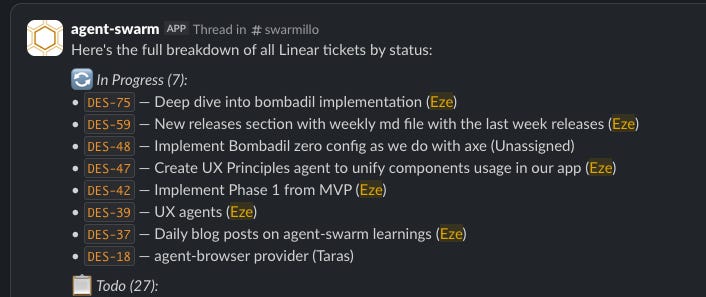
In 2026, AI native Individual Contributor has now the influence and role of at least the former jr. manager.
First: Delegate ownership, not accountability
The most basic principle, and the most forgotten one, as a leader you own the failure, and you share the success. This is the core of ownership vs accountability.

I’ve seen many inexperienced leaders fail at this in all roles. And I was a victim of some of these early in my career. They believed that someone doing their job poorly in their team justified not meeting a deadline, and that their performance was still brilliant. It wasn’t. Others would burnout taking on the heavy load from the rest of the team with a simple: “I can code faster than them”. The best ones, though, would build mechanisms in place to ensure things happened in time and manner.
Initially, they would lean heavily on choosing teammates that are “up to their standards”, they’ll invest heavily in hiring, mentoring, and firing, trying to ensure each team-member is perfect. Eventually this, even though necessary, won’t be enough. When a code-base/solution/organization grows sufficiently, smart people also need context. Onboarding becomes a challenge, and you don’t have the time to constantly train your team on what other 100 people are doing in a remote office. At that point, the answer is unequivocally ‘safeguards’, a.k.a. ‘guardrails’.
This was the thesis behind all our products at Desplega Labs, and the first manager intuition that paid off. Every time I found myself reviewing an issue with our system, the question was: why did this happen?
Three examples that reflect on that:
Agent swarm user database.
Agent swarm kept confusing me with Taras in our different platforms. Linear, Github, Slack, email. Even though it had definitions and relationships defined in different MDs, it struggled to keep those relationships working.
This is how our Unified user identity system came to be.Agent swarm Coordination challenge
I found myself actually coordinating tasks way too often. Even though our swarm run with different worktrees, and separate, isolated agents, the tricky part was ensuring things happened in the ‘correct order’.
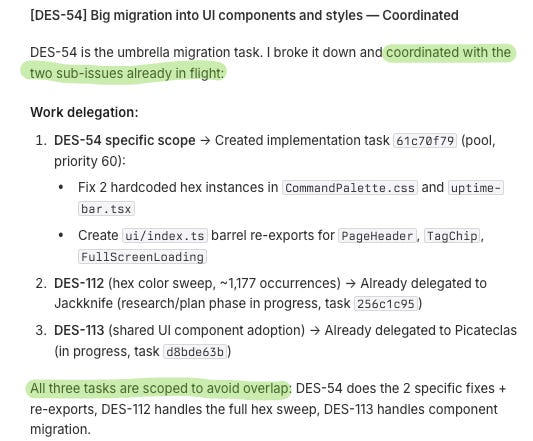
Three different overlapping tasks, organized on the fly, while two were already running.
We decided the agent leader should be more aggressive in coordinating tasks. There’s no single PR on this, it’s the system that ensures we check similar tasks happening and we coordinate internally.Litmus tests for all communications
Every time we generated content for marketing or our users, my question was the same: is this meant for my audience?
That’s when I started implementing litmus tests for each content piece. Initially it was quite simple, one pass, one score, if bad, throw it out.
Nowadays, it’s a complex loop that can decide if we need to start from scratch and choose a completely different approach, or if it can be fixed with minor adjustments. It also has a powerful DB to avoid repeating itself, use the right tone, tags, and images according to our branding.
By the end, the work produced is ‘good-enough’ to be reviewed weekly or even less.
The motivation is always the same: we are accountable for the outcomes, their quality, effectiveness and efficiency, even if we don’t own the implementation. The mindset then, is that of systematically understanding the whole, and focusing on accelerating the parts. Which takes us to our second point.
Second: Eliminate the Toil
Understanding that the only way to make significant progress is to make yourself redundant is the most dreaded question by ICs. Individual Contributors tend to see their job as a static set of tasks. In fact, they are not used to the idea of infinite work.
“My day always ends when I’m tired and ready to go home, not when I’m done. I’m never done”. – Andrew Grove; High Output Management.
Truth is closer to Parkinson’s Law, work expands. Managers know latency is the silent killer in business, and that whenever you delegate, it’s fundamental you take on the immediate next hot topic. It’s never enough, you can always do more, faster, and better. You need to do this, because everyone is doing this, and because your customers deserve it.
Add to that the ever-growing definition of Toil. Three years ago, SEO required a lot of unavoidable manual labor. Generating a glossary in your website, consistently posting content for different audiences, refreshing your content periodically, adding the right meta tags, including the relevant links, creating appealing header images, etc. You needed a team to produce just 4 entries a week, and most of these tasks seemed unaffordable to automate. My Marketing Growth journey started there.
I created my early tinkering with a Content Strategist. It would suggest topics, do some web search, eventually even write a draft. However, the work was tedious. What happened since day one:
It would repeat itself, and I would need to correct it. So I added a DB.
It would forget who to write for. So I added the reviewer agent mentioned before.
It would struggle to generate images. So I started using imgflip to generate wonderful memes.
It would still require me to prompt to code it. So I integrated it into our repo, and CI/CD.
It would run on my laptop… So I started using agent-swarm.dev.
Eventually it became such a powerful thing that for 5 minutes every morning I would review the content, and simply say ‘not today’, when it wasn’t really adding value. We also started using it to generate our releases, FAQs, and more documentation.
Today I don’t have less work, I have other jobs. That’s the interesting thing. At the end of the day, you will need to keep defining tasks, and your job will start looking more and more as a Leader than an IC. Nowadays, I review once a week how our SEO is doing, and I ask myself what new topics should we be looking into. That’s the job, to make sure each day you are one step higher.
Third: Decisions make or break careers.
Today the choice for any Individual Contributor is how much they want to own. Should they own:
The input, features delivered, lines of code contributed, etc,
input & output, quality & reliability of the features delivered, or
the outcome, usage, revenue, engagement, etc…
Managers intuitively chose outcome over output, and output over input. That’s how they grow their teams. They consistently ask themselves, how is my team helping the company succeed? Furthermore, they are trained to pick those critical projects with high likelihood of success that balance perfectly with risk. That’s their job, and the more senior they are, the more they excel at making critical decisions.
In You Have a Choice, Eric argues you “decide whether to just react as we have always done previously, or to choose a new option that might open up new possibilities of growth”. Through that thought process, it’s important to understand the role of a leader, and how our influence changes as we partner in different capacities with an organization.
That’s the mindset that allows you to introduce real changes. My last two contributions to desplega.ai weren’t fast to code, or direct improvements. In fact, by all metrics, I am probably coding less in desplega.ai than 3 months ago. However, our users truly benefit from these additions:
Shared test caches
I focused for a month on sharing browser state across tests. This meant sharing login credentials (think multi-tab login) across different browser instances. Implementing this resulted in direct savings for our customers, they literally consume less tokens and their tests run faster. Win-win-win.Self-improving tests
We implemented a Night Agent that periodically revisits tests and tries to improve them following a formula that considers reliability, speed, and cost. Again, something that if we had to be taking care of every little fix in our app, we wouldn’t be able to tackle. Now we had time for the big things, while redesign happens in the background.
The one thing: Only the Paranoid Survive.
Truth is most managers will also fail. Even those that have been labelled as superstars. Superstars came to a job with a playbook, they talked about their experience and how they did it in the past. They seldom talked about the new world. Those overconfident leaders are the real risk.
“The person who is the star of the previous era is often the last one to adapt to change, the last one to yield to the logic of a strategic inflection point and tends to fall harder than most.” - Andrew S. Grove, Only the Paranoid Survive.
The Paranoid, always looking outside, always chasing what others are doing better, always improving themselves and their teams, always looking at users & competitors. Those will be your successful ones. Those that constantly doubt their methodologies, adapt their playbook, and recognize they need constant help keeping up-to-date.
If you are asking yourself why do I spend so much time learning, and spreading those learnings, it’s because technology is getting deprecated faster than most can learn it. Your teams cannot take care of the day to day while keeping up with the latest trends. It’s not about years, it’s about weeks.
That’s my paranoia, it’s knowing that What Got You Here Won’t Get You There.